

If you have spent any time researching modern health, fitness, wellness or biotechnology, you have probably come across the word “peptide.”
Peptides are increasingly discussed online, but the term is often surrounded by complicated scientific language, marketing claims and confusion about what peptides actually are.
So, what exactly is a peptide?
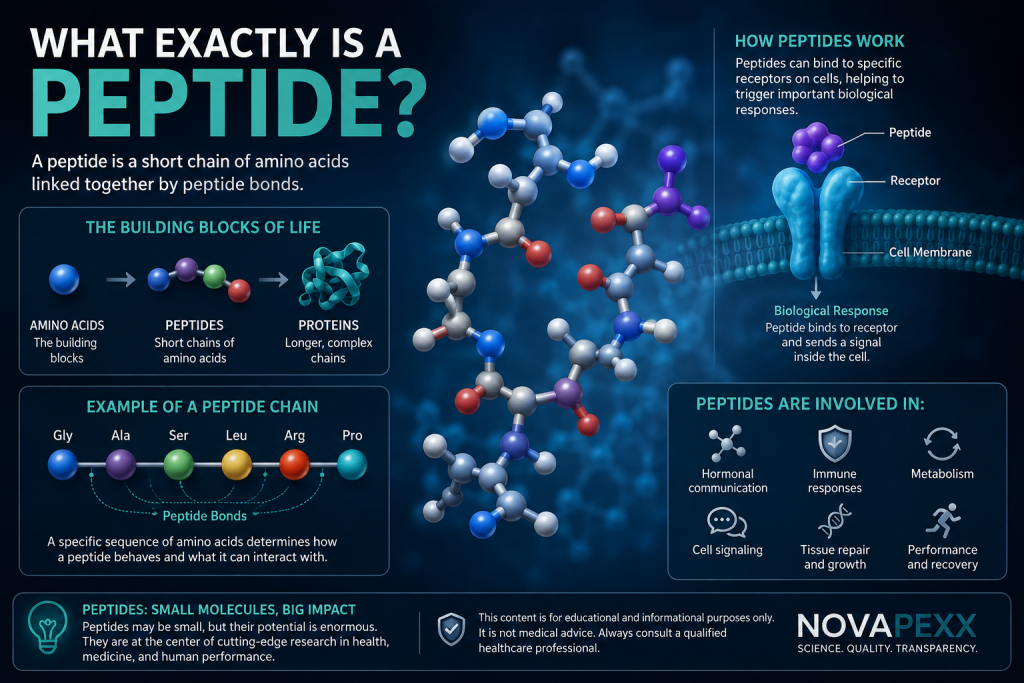
In simple terms, a peptide is a short chain of amino acids linked together by peptide bonds. Amino acids are the building blocks used to make proteins, and peptides are essentially smaller chains of these same building blocks.
That sounds simple, but peptides play an enormous range of roles in biology and scientific research.
In this guide, we’ll break down what peptides are, how they differ from proteins, how they occur naturally in the body, why they are important in biological research, and why the subject has attracted so much attention.
What Are Peptides?
To understand peptides, it helps to start with amino acids.
Amino acids are organic molecules that can join together to form chains. When two or more amino acids link together, they form a peptide.
The amino acids are connected through chemical bonds called peptide bonds.
A simplified way of looking at it is:
Amino acids → Peptides → Proteins
The distinction isn’t always as simple as counting the number of amino acids, because scientific definitions can vary. Generally, peptides are shorter chains of amino acids, while proteins are larger and more complex molecules that can fold into specific three-dimensional structures.
The sequence of amino acids matters enormously. Changing the order of the amino acids can change how a peptide behaves and what it can interact with.
Peptides vs Amino Acids vs Proteins
These three terms are often confused, so let’s make the difference straightforward.
Amino acids
Amino acids are the individual building blocks.
Think of them as individual letters.
Peptides
Peptides are chains made from amino acids.
Think of them as words formed by putting those letters together.
Proteins
Proteins are generally much larger molecules made from one or more amino-acid chains that fold into complex structures.
Think of proteins as much longer sentences or books made from those same letters.
This analogy isn’t scientifically perfect, but it makes the basic relationship easier to understand.
How Are Peptides Made?
Peptides can occur naturally in living organisms, but they can also be produced through laboratory processes.
In biological systems, cells use sophisticated molecular machinery to create proteins and peptide molecules according to genetic instructions.
Scientists can also manufacture peptides using techniques such as solid-phase peptide synthesis (SPPS).
Laboratory peptide synthesis has become an important tool in modern biochemistry and pharmaceutical research because researchers can produce specific peptide sequences for laboratory investigation.
The resulting molecule can then be studied to understand its structure, interactions and biological activity.
Do Peptides Naturally Occur in the Human Body?
Yes.
Peptides are naturally present throughout the human body and are involved in numerous biological processes.
Some naturally occurring peptides act as signalling molecules. Others participate in immune responses, tissue processes or communication between cells.
One important category is peptide hormones.
For example, insulin is a peptide hormone involved in regulating blood glucose levels.
Other naturally occurring peptide molecules have roles in areas such as:
Cell signalling
Hormonal communication
Immune responses
Metabolism
Tissue regulation
Communication between cells
Biological defence mechanisms
This is one reason peptides are so interesting to scientists: relatively small molecules can have highly specific interactions within biological systems.
Why Do Peptides Matter?
The importance of peptides comes largely from their ability to interact with other molecules.
A peptide’s amino-acid sequence determines its structure and chemical characteristics. That structure can allow it to interact with particular receptors, proteins or other biological molecules.
This makes peptides particularly interesting in biochemistry, biotechnology and pharmaceutical research.
Researchers can investigate how particular peptide sequences interact with biological systems and whether those interactions could have useful applications.
Importantly, this does not mean that every peptide has a therapeutic effect or that every peptide product is safe or effective.
A peptide is a broad category of molecule, not a guarantee of a particular outcome.
What Is a Peptide Receptor?
You may also hear the term “receptor” when reading about peptides.
A receptor is essentially a biological structure that can recognise and interact with particular molecules.
A useful analogy is a lock and key, although real biological interactions are much more complicated.
Some peptides can bind to specific receptors on or inside cells. When this happens, the interaction can influence cellular signalling pathways.
This is one of the fundamental areas researchers investigate when studying biologically active peptides.
Why Are Peptides So Popular in Scientific Research?
Peptides occupy an interesting position between small molecules and larger proteins.
Their relatively small size can make them useful research tools, while their specific amino-acid sequences can allow researchers to investigate highly targeted biological interactions.
Scientists study peptides in areas including:
Drug discovery
Researchers investigate peptide molecules as potential starting points for developing new medicines and therapeutic approaches.
Molecular biology
Peptides can help scientists understand how biological molecules interact.
Biotechnology
Peptides can be investigated for applications ranging from diagnostics to biomaterials.
Structural biology
Researchers can study how peptide sequences influence molecular structure and biological activity.
Cell signalling
Some peptides participate in signalling pathways, making them useful for understanding communication between cells.
Are All Peptides the Same?
Definitely not.
“Peptide” describes a broad class of molecules rather than one particular substance.
Different peptides can have completely different:
Amino-acid sequences
Lengths
Structures
Chemical properties
Biological targets
Mechanisms of action
Research applications
Two molecules can both technically be peptides while behaving very differently.
This is an important distinction when researching peptide products or peptide-related information online.
You should always look at the specific peptide, rather than assuming that everything labelled as a peptide will have the same properties.
Peptides and Proteins: What’s the Difference?
The biggest difference is generally size and structural complexity.
Peptides tend to be shorter amino-acid chains, while proteins are larger molecules that often fold into complex three-dimensional structures.
However, there isn’t a single universally accepted amino-acid number that perfectly separates every peptide from every protein.
Some scientific and biochemical contexts use different terminology depending on molecular size, structure and function.
So rather than thinking of peptides and proteins as completely separate categories, it is more accurate to think of them as being part of the same broader family of biological molecules.
What Does “Bioactive Peptide” Mean?
Another term you may encounter is bioactive peptide.
A bioactive peptide is a peptide that can interact with biological systems and produce a measurable biological effect.
These peptides may be naturally occurring or produced through scientific and industrial processes.
The term “bioactive” does not automatically mean “beneficial,” “therapeutic” or “safe.”
It simply refers to biological activity.
This distinction is particularly important when evaluating information online, where scientific terminology can sometimes be used in marketing in ways that imply more than the available evidence actually demonstrates.
How Are Peptides Studied?
Researchers use a variety of techniques to investigate peptides.
Depending on the research question, scientists may study:
Molecular structure
Amino-acid sequence
Receptor interactions
Stability
Biological activity
Absorption and distribution
Metabolism
Cellular responses
Potential toxicity
Pharmacological properties
Laboratory research can involve in vitro experiments, meaning experiments performed outside a living organism, as well as animal studies and, where appropriate, human clinical research.
Each type of evidence provides different information.
A result observed in a laboratory experiment does not automatically mean the same effect will occur in humans.
Are Peptides Medicines?
Some peptide-based molecules are used as medicines, but not every peptide is a medicine.
This distinction is extremely important.
A peptide can exist as:
A naturally occurring biological molecule
A laboratory research compound
A pharmaceutical ingredient
A component of a diagnostic technology
A biotechnology research tool
A peptide studied for potential future applications
Whether a particular peptide is approved for medical use depends on the specific substance, formulation, indication, evidence and regulatory authority involved.
Therefore, the word “peptide” alone tells you very little about whether a particular product is suitable for human use.
What About Peptides Used in Research?
You may encounter products described as research peptides.
This generally refers to peptides supplied for scientific or laboratory research rather than as approved medicines.
The distinction between research use and medical use is important.
A compound being investigated by scientists does not necessarily mean that it has been proven safe or effective for use in humans.
Research findings also develop over time. Early laboratory results may eventually lead to further investigation, but they do not automatically establish clinical effectiveness.
This is why credible scientific information should distinguish between:
What is known → What is being researched → What remains uncertain.
Why Is Peptide Quality Important?
When scientists work with peptides, purity and identity are important considerations.
A researcher’s results can be affected if a sample contains unexpected impurities, degradation products or an incorrectly synthesised sequence.
Depending on the application, analytical techniques such as high-performance liquid chromatography (HPLC) and mass spectrometry (MS) may be used to characterise peptide materials.
For research purposes, documentation such as analytical testing and certificates of analysis can therefore be important when assessing a peptide material.
However, testing documentation should not be confused with regulatory approval or proof that a compound is appropriate for human consumption.
Are Peptides Safe?
There is no single answer because “peptides” are not one substance.
Safety depends on the specific peptide, its characteristics, how it is formulated, how it is administered and the context in which it is being used.
A peptide naturally produced by the human body is not automatically equivalent to a laboratory-produced peptide.
Likewise, a peptide that has been studied in a scientific setting is not automatically safe for self-administration.
Anyone considering a peptide for medical or personal use should consult an appropriately qualified healthcare professional and rely on evidence from reputable sources.
The Difference Between Peptide Science and Peptide Marketing
The growing interest in peptides has also created a huge amount of online marketing.
You may see claims suggesting that particular peptides can:
Transform body composition
Reverse ageing
Dramatically improve performance
Repair virtually any tissue
Treat multiple unrelated conditions
Such claims should be approached carefully.
The fact that a peptide has a biological mechanism does not automatically prove that a commercial product will produce a particular result in humans.
Good peptide science starts with evidence.
That means considering the quality of the research, the study design, the population studied, the dose or exposure, the route of administration and whether the findings have been independently reproduced.
Why Are Peptides Becoming So Interesting?
Peptide science sits at the intersection of biology, chemistry, medicine and biotechnology.
Advances in peptide synthesis, molecular biology and analytical chemistry have made it possible for researchers to investigate increasingly sophisticated peptide molecules.
At the same time, researchers are exploring ways to improve peptide stability, delivery and specificity.
This has contributed to growing interest in peptides across scientific research and pharmaceutical development.
But increased interest also makes it more important to separate established science from speculation and marketing hype.
A Simple Way to Remember What a Peptide Is
If you remember only one thing from this article, remember this:
A peptide is a chain of amino acids connected by peptide bonds.
Those chains can range from relatively simple molecules to highly sophisticated biological signalling molecules.
Some occur naturally in the human body.
Some are found in food and other biological materials.
Some are manufactured in laboratories.
Some are investigated as potential medicines.
And others are primarily used as research tools.
The word “peptide” describes the type of molecule — not what that molecule does.
Frequently Asked Questions About Peptides
Is a peptide a protein?
Peptides and proteins are both made from amino acids, but peptides are generally shorter and less structurally complex. There is no single universal boundary that perfectly separates every peptide from every protein.
Are peptides naturally occurring?
Yes. Many peptides occur naturally in humans, animals, plants and microorganisms.
What are peptides made from?
Peptides are made from amino acids linked together through peptide bonds.
What is a peptide bond?
A peptide bond is a chemical bond that forms between amino acids when they join together to create a peptide or protein chain.
Are peptides hormones?
Some peptides function as hormones, but not all peptides are hormones. “Peptide” describes the molecular structure, while “hormone” describes a biological signalling role.
Are peptides the same as amino acids?
No. Amino acids are individual building blocks, while peptides are chains made from amino acids.
Are all peptides safe?
No. Safety depends on the specific peptide and how it is used. The term “peptide” by itself does not indicate that a substance is safe, approved or suitable for human use.
Are research peptides approved medicines?
Not necessarily. A peptide being investigated for research purposes does not mean it has been approved as a medicine or evaluated for a particular medical use.
The Bottom Line
Peptides are much more than a trend.
They are a fundamental part of biology and an important area of modern scientific research.
At their most basic level, peptides are short chains of amino acids. Yet those relatively small molecules can participate in highly sophisticated biological interactions.
As peptide research continues to develop, scientists are learning more about how these molecules interact with cells, receptors and other biological systems.
For anyone exploring the world of peptides, the best starting point is understanding the science behind the word itself.
Peptides are not one product, one treatment or one category of health benefit. They are a broad class of molecules with an enormous range of biological properties and potential applications.
At NovaPexx, our goal is to help make peptide science easier to understand by separating science from hype and providing clear, accessible information about the rapidly developing field of peptide research.
Disclaimer: This article is provided for general educational and informational purposes only. It is not medical advice and should not be interpreted as a recommendation to use, purchase, administer or consume any particular peptide. Research status, regulatory status and scientific evidence can differ substantially between individual peptides. Always consult a qualified healthcare professional for medical advice.
