
What Are the Different Uses of Different Peptides?
Peptides have become one of the most talked-about areas in modern health, wellness, sports science and biomedical research. From supporting scientific research into tissue repair and metabolism to playing important roles in naturally occurring processes in the human body, peptides cover an incredibly broad range of functions.
But what exactly are different peptides used for?
The answer isn’t as simple as saying that all peptides do the same thing. Different peptides have different structures, interact with different receptors and biological pathways, and therefore can have very different effects.
Some peptides are naturally produced by the body, some are used as medicines, and others are primarily investigated in laboratory and research settings.
In this guide, NovaPexx explores the major categories of peptides and the different purposes they are associated with.
Important: This article is provided for educational purposes only. Peptides can have significant biological effects, and research status, regulatory approval and appropriate use vary between individual compounds and countries. Information about a peptide’s potential use should not be interpreted as medical advice or a recommendation to use any particular compound.
What Is a Peptide?
Before looking at the different uses of peptides, it helps to understand what a peptide actually is.
A peptide is a short chain of amino acids. Amino acids are the building blocks of proteins, and peptides can act as important signalling molecules within the body.
Some peptides function as hormones or hormone-like messengers, while others interact with receptors involved in processes such as metabolism, inflammation, tissue signalling and cellular communication.
Their relatively small size also allows peptides to interact with highly specific biological targets.
This is one reason researchers are so interested in them.
However, being a peptide does not automatically mean that a compound has the same purpose as another peptide. Two peptides can have completely different structures and biological functions.
The Different Uses of Peptides
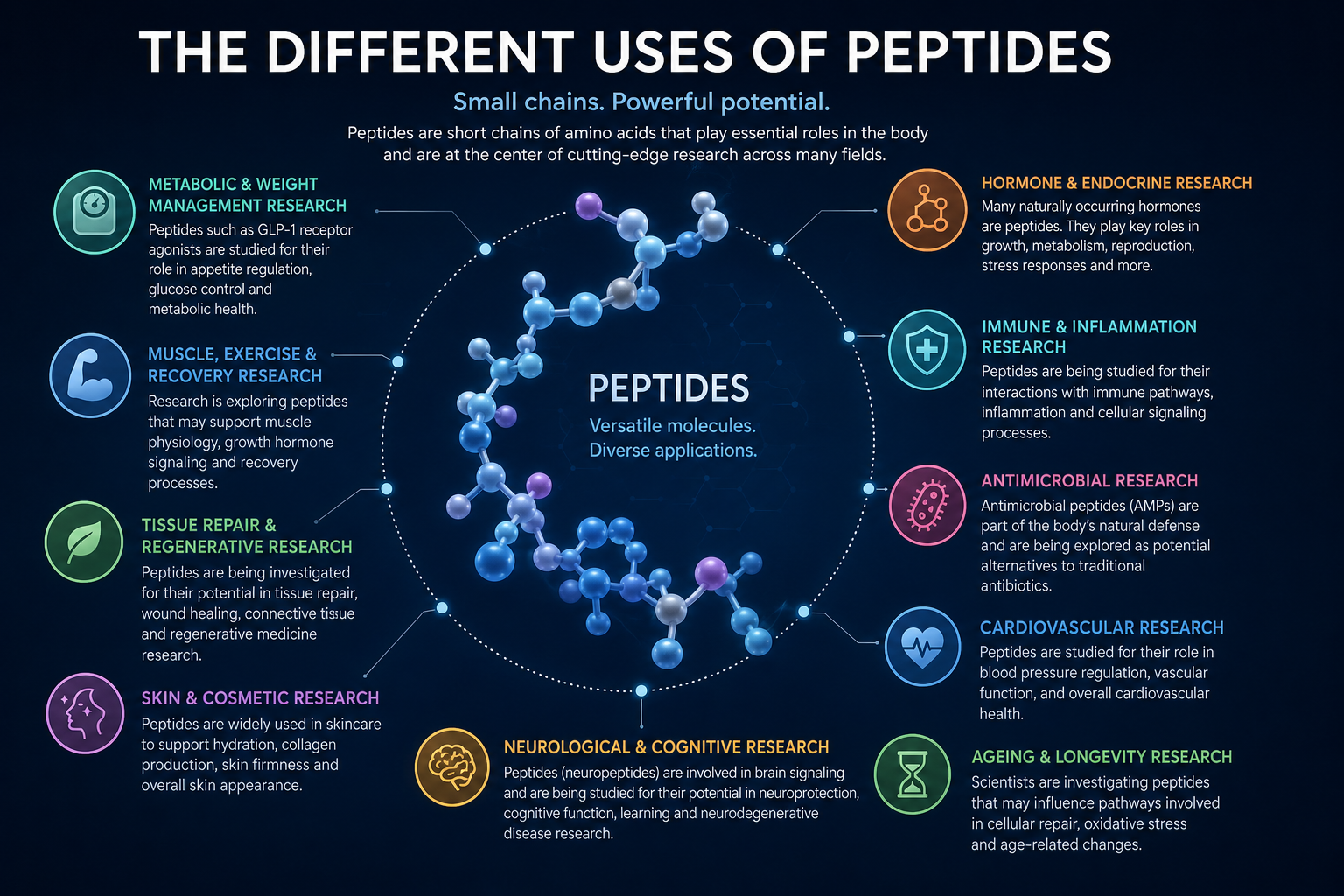
Peptides are being studied or used across numerous areas of biology and medicine. The following categories provide a useful overview.
1. Metabolic and Weight-Management Research
One of the most widely discussed applications of peptide-based medicines is metabolic health.
Certain peptides interact with pathways involved in appetite, digestion, glucose regulation and energy metabolism. Some modern medications used for metabolic conditions are based on peptide hormones or peptide-related mechanisms.
For example, GLP-1 receptor agonists work by mimicking or activating pathways associated with glucagon-like peptide-1 (GLP-1), a naturally occurring hormone involved in blood-glucose regulation and appetite.
Other compounds have been investigated for their effects on multiple metabolic pathways.
Why are these peptides interesting?
Researchers are particularly interested in peptides that may influence:
Appetite and satiety
Blood-glucose regulation
Insulin signalling
Energy metabolism
Body-weight regulation
Metabolic health
It’s important to distinguish between approved peptide medicines and compounds that are still experimental or being investigated. A peptide appearing in research does not necessarily mean it is an approved treatment for weight management.
2. Muscle, Exercise and Recovery Research
Peptides are also widely discussed in sports science and research relating to muscle and physical recovery.
Some peptides have been investigated for their potential influence on biological pathways associated with growth hormone signalling, tissue repair or recovery.
Growth-hormone-related peptides, for example, have been studied because certain compounds can influence the body’s growth hormone signalling pathways.
Researchers have also investigated peptides in relation to:
Muscle physiology
Exercise recovery
Growth hormone signalling
Physical performance
Tissue recovery
However, this area requires particular caution.
A peptide being investigated for exercise or recovery does not mean that it is proven to improve athletic performance or is approved for that purpose.
Athletes should also be aware that certain peptide compounds may be prohibited under applicable anti-doping rules.
3. Tissue Repair and Regenerative Research
Another major area of peptide research involves tissue repair and regeneration.
Some peptides are being investigated for their potential effects on biological processes involved in cellular signalling, blood-vessel formation, inflammation and tissue repair.
One commonly discussed example is BPC-157, which has generated considerable interest in research communities. Research involving BPC-157 has investigated biological processes related to tissue repair, although much of the evidence remains preclinical.
Other peptides are also being researched for potential roles in:
Connective tissue research
Tendon and ligament research
Gastrointestinal research
Cellular signalling
Tissue regeneration
This is an area where it is particularly important not to confuse experimental research with established human treatments.
Results observed in laboratory or animal studies cannot automatically be assumed to occur in humans.
4. Skin and Cosmetic Research
Peptides are also extremely common in skincare and cosmetic formulations.
Unlike injectable or systemic peptide compounds, many cosmetic peptides are incorporated into topical products such as creams, serums and moisturisers.
Certain cosmetic peptides are researched for their potential role in supporting the appearance and condition of the skin.
They may be included in formulations designed around:
Skin hydration
The appearance of fine lines
Skin firmness
Collagen-related pathways
Skin barrier support
General skin appearance
Copper peptides are one example of a peptide family frequently discussed in cosmetic and skincare research.
The important distinction here is that a cosmetic peptide product is not necessarily equivalent to a pharmaceutical peptide or research compound.
The formulation, concentration, route of administration and intended use can be completely different.
5. Hormone and Endocrine Research
Many naturally occurring hormones are peptides or proteins, meaning peptides play an important role in the body’s endocrine system.
Peptide hormones can act as chemical messengers, helping regulate processes throughout the body.
Examples of peptide-related hormonal signalling include pathways associated with:
Growth
Metabolism
Reproduction
Blood-glucose regulation
Appetite
Fluid balance
Stress responses
Because of their role in hormonal signalling, peptide-based compounds have become an important area of pharmaceutical research.
Some peptide medicines have already been developed to mimic, replace or modify naturally occurring hormonal signals.
6. Neurological and Cognitive Research
Researchers are also investigating peptides in relation to the nervous system.
The brain contains numerous signalling molecules, including peptide-based messengers known as neuropeptides.
Neuropeptides can participate in communication between neurons and influence a wide variety of physiological processes.
Research into peptides and the nervous system includes areas such as:
Neuronal signalling
Brain function
Neuroprotection
Memory and learning
Stress responses
Neurodegenerative disease research
However, this is another field where online claims can easily go beyond the available scientific evidence.
A peptide being investigated for a neurological pathway does not mean it has been demonstrated to improve memory, intelligence or cognitive performance in humans.
7. Immune and Inflammation Research
The immune system relies on an enormous network of signalling molecules, and peptides are involved in several of these biological processes.
Researchers are investigating different peptides for their potential interactions with pathways involved in:
Immune responses
Inflammatory signalling
Cellular communication
Oxidative stress
Tissue responses
Understanding these pathways could potentially contribute to the development of future therapies.
Again, the distinction between research interest and proven clinical benefit is essential.
8. Antimicrobial Research
Some peptides have natural antimicrobial properties.
These are often referred to as antimicrobial peptides (AMPs) and form part of the innate immune defences of many organisms.
Researchers are particularly interested in antimicrobial peptides because they may interact with microorganisms in ways that differ from conventional antibiotics.
Research into antimicrobial peptides includes potential applications involving:
Bacteria
Fungi
Certain viruses
Biofilms
Antimicrobial resistance
This is an especially interesting area of peptide research because antibiotic resistance is an increasingly important global scientific challenge.
9. Cardiovascular Research
Peptide signalling is also involved in cardiovascular physiology.
Researchers have studied peptides associated with processes such as blood-vessel function, blood pressure regulation and cardiac signalling.
Some peptide-based medicines have been developed for cardiovascular conditions, while other peptides remain under investigation.
Research areas include:
Blood-vessel signalling
Blood pressure regulation
Cardiac function
Fluid balance
Vascular biology
This demonstrates how broad the field of peptide science really is.
10. Research Into Ageing and Longevity
Peptides are also frequently discussed in longevity research.
Scientists are investigating a variety of biological pathways associated with ageing, cellular damage, metabolism and tissue maintenance.
Some experimental peptides have attracted attention because researchers are interested in whether they may influence pathways associated with:
Cellular signalling
Metabolic processes
Oxidative stress
Tissue maintenance
Cellular repair
Age-related biological changes
However, there is currently no single peptide that can simply be described as an “anti-ageing peptide.”
Longevity is an extremely complex biological process involving genetics, metabolism, cellular function, lifestyle and numerous other factors.
Why Do Different Peptides Have Different Uses?
The key lies in their structure and biological target.
A peptide’s sequence of amino acids determines its three-dimensional structure and influences how it interacts with biological receptors and signalling pathways.
Think of receptors as specialised locks and biological molecules as keys.
A particular peptide may fit and activate one receptor, while another peptide may interact with a completely different receptor.
This means changing even a relatively small part of a peptide can potentially alter its biological activity.
That’s why peptides shouldn’t be treated as one broad category.
GLP-1-related compounds, collagen peptides, antimicrobial peptides, cosmetic peptides and experimental research peptides can have entirely different purposes.
Research Peptides vs Approved Medicines
This distinction is incredibly important when researching peptides online.
There are several different categories of peptide products and compounds.
Approved peptide medicines
Some peptides and peptide-based medicines have undergone extensive clinical research and have received regulatory approval for specific medical indications.
Their approved use depends on the particular medicine, dosage form and country.
Clinical-stage peptides
Some peptides are being investigated in human clinical trials but have not yet received regulatory approval for a particular use.
Preclinical research compounds
Other peptides are studied primarily in laboratory or animal research.
These compounds may be scientifically interesting but do not necessarily have established safety or efficacy in humans.
Cosmetic peptides
Some peptides are incorporated into topical skincare products and have different regulatory requirements and intended uses from pharmaceutical products.
Understanding this distinction helps prevent one of the biggest misconceptions surrounding peptides: research does not automatically equal proven treatment.
How Should You Research a Peptide?
Before considering any peptide, it’s worth looking beyond social media claims and marketing descriptions.
A responsible approach is to ask:
1. What is the peptide?
Understand its structure and biological target.
2. What is it being researched for?
Determine whether the proposed use is supported by laboratory, animal or human research.
3. Is it approved for that purpose?
Regulatory approval matters.
4. What human evidence exists?
Human clinical trials generally provide much stronger evidence than anecdotal reports or animal studies.
5. What are the known risks?
Biological activity can also mean potential side effects or interactions.
6. How is the compound administered?
The route of administration can significantly affect a compound’s behaviour and safety.
7. Is the product appropriately tested and sourced?
Quality, identity, purity and contamination are important considerations with any biologically active compound.
The Future of Peptide Science
Peptide research is expanding rapidly.
Scientists are investigating new peptide structures, improving how peptides are delivered into the body and developing compounds capable of targeting increasingly specific biological pathways.
Advances in biotechnology are also making it possible to design and modify peptides with greater precision.
Potential future developments may involve:
More targeted medicines
Improved drug-delivery systems
Personalised therapies
New metabolic treatments
Regenerative medicine research
Antimicrobial therapies
Neurological research
The versatility of peptides makes them an exciting area of modern biomedical science.
Final Thoughts
There is no single answer to the question “What are peptides used for?”
Peptides are an enormous and diverse group of biological molecules, and different peptides can have completely different functions.
Some are involved in naturally occurring processes within the human body. Others are used in approved medicines. Some are used in cosmetic formulations, while many others are still being investigated in laboratories and clinical research.
From metabolic and hormonal research to tissue repair, skincare, antimicrobial science and neuroscience, peptides represent one of the most diverse areas of modern biotechnology.
At NovaPexx, we believe that understanding the science behind peptides is just as important as understanding the individual compounds themselves.
Research first. Understand the science. Make informed decisions.
Disclaimer: NovaPexx provides educational information about peptides and related scientific topics. The information presented on this website is not intended to diagnose, treat, cure or prevent any disease or medical condition and should not be considered medical advice. Research status and regulatory approval vary between compounds and countries. Always consult an appropriately qualified healthcare professional before making decisions regarding your health or the use of any biologically active compound.
